Showing posts with label 5 stars. Show all posts

Tuesday, August 01, 2023

Ejaculate Responsibly: A Whole New Way to Think About Abortion, Gabrielle Blair


George Wallace, Lazarus Risen From the Dead, 1983

(July 28)


Thursday, October 01, 2020

The Secret History, Donna Tartt


Head of Hermes from the Orpheus Relief, 450-400 BCE 

(September 7)


Friday, November 01, 2019

Conversations With Friends, Sally Rooney

Eileen OʼSullivan, Multiplicity of Factors, 2015
(October 26)  I just inhaled this novel -- read it in less than 24 hours, almost all at once (a second sitting for the last 40 pages). 

Such an interesting and intriguing voice this first-person narrator has, and I was totally sucked into the love affair that is the focus of the book -- a completely unconventional love affair that is nonetheless conventionally compelling, but is bathed in layers of irony so deeply that it’s almost a comic novel.... except it literally is a romance. Desperate to read more Rooney, but she’s young and has barely started.

I learned of this from Habitually Chic’s Instagram.

Friday, March 31, 2017

The Hidden Life of Trees, Peter Wohlleben (translated by Jane Billingshurst)

Patricia Kozowyk, Winter Woods, 1993
(April 14) I really loved this book -- the things trees are doing and going through are amazing... It gets to be a cliché in the book, but it’s like finding out that animals have emotions or that foreign people “are just like us.”

I have always liked and anthropomorphized trees and I like to project compliments and mental support at them when travelling but now I am in absolute awe of them, and feeling very maternal about them.

The fact that they communicate with each other, and with other plants, and look after each other, and raise their children -- it’s all quite stunning and beautiful.

And Wohlleben has such a lovely way of writing about them -- he is so gentle and loving in his descriptions of them, you can’t help but feel he’s talking about another kind of human being -- for example, he calls tree seedlings “tiny conquistadors” when describing their efforts to conquer new worlds.

Wohlleben may also have referenced Suzanne Simard’s TED talk since she was the one who discovered that trees and fungi use each other to share information and nutrients, but I seem to have heard about both the book and the talk around the same time separately.

Really makes you want to be an eco-warrior.

Saturday, April 09, 2016

The Stench of Honolulu, Jack Handey


Salvador Dali, Ship With Butterfly Sails, 1937
(April 3) Jack Handey is so surreal but so hilarious… all I want to do is quote from this book over and over till I’ve copied out the whole thing.

OK, here are five random book openings:
I’ve always wanted to be an inventor. But the “powers that be” have decided the world doesn’t need things like the cardboard canoe, for when you only feel like canoeing for an hour or so and you’re too lazy to drag your canoe out of the water.
I littered for miles. I was starting to get bored when, out of the blue, a patch of bright green appeared. I was tickled pink. It was a golf course, with a big clubhouse set in the middle. Finally, something in Hawaii that was pretty.
The red boat chugged past us upriver. My plan had worked. I turned to Leilani. I wanted to gloat, but as a man I had other desires. I wanted to tell her how I had been right and she had been wrong. Wait, I guess that’s gloating.
Don and I nodded agreement. Is it wrong to lie because you’re planning to steal something? That’s a question probably only the philosophers can answer. One thing I knew for sure: The Golden Monkey did not want to be gawked at. He wanted to be melted down into smooth little ingots and smuggled to America inside someone’s rectum.
He twisted, just in time to get another volley of sticks in the back, then twisted again to get some more in the front. He lurched back and forth. A couple of late sticks bounced off his head. He looked like a porcupine, only not a regular porcupine -- a porcupine of sticks.
Completely random, but to me all completely hilarious.

Monday, April 20, 2015

The First Bad Man, Miranda July

Miranda July, from Kids Activity Pages for Apartamento Magazine, 2011

(April 20) I loved this book. I laughed helplessly on every page.

It’s all crazy and improbable stuff but it’s, like, that never matters, fundamentally.

Tuesday, April 30, 2013

Cold Mountain, Charles Frazier

John R. Chapin, In the Trenches at Cold Harbor, 1890
(October 2) I found this a very powerful book -- very hard to read, actually -- I had to steel myself to it every time I read it, as much as I loved it, and I spoke to more than one person who found it too hard to finish. Pat said it was “too violent” which is true, but it’s not always man vs. man violence -- in fact, it’s much more just the regular violence of nature and what it’s like to live in the mountains in the 1860s in the middle of a war. Frazier is a graphic, vivid describer and can be heartless with the details. He plays hard ball. It makes the stakes high. I especially had to steel myself to read the ending, for you had no idea whether he would spare Inman and Ada.

It’s kind of picaresque, but there is this overarching form of Inman returning to Ada, a quest whose significance increases and becomes ever more gripping even though the two are apart for so long. It’s a clever device. The more time we spend with Ada and Inman, the more we get of their memories, which at the beginning don’t hint at the depth of the relationship. It’s definitely Odysseus returning to Penelope and his kingdom, but here the relationship is so much more the driving passion.

The vivid details of mid-19th-century life in the southern U.S. are amazing, totally engrossing. I feel like Frazier got the habits of speech right, too. There are oddnesses of expression and vocabulary that you see in letters and newspapers of the time.

Was surprised by some of the Penthouse scenes at the end. LOL

Had a great writing style in general… very rich. Anything Inman thinks or says is interesting (“a sermon of Monroe’s, dense to the point of clotting”) and on and on.

The love story -- so moving -- so excruciating -- like a Jane Austen parlour.

Gripping, bracing, all those words that convey high-tension wire binding you thrillingly to a dangerous ride.

A passage I found very profound: “And then she thought that you went on living one day after another, and in time you were somebody else, your previous self only like a close relative, a sister or brother, with whom you shared a past. But a different person, a separate life. Certainly neither she nor Inman were the people they had been the last time they were together. And she believed maybe she liked them both better now.”

The most treacherous, perfidious, soul-wrenching sentence I have ever read in a book: “Even after all this time and three children together, Ada still found them clasping each other at the oddest moments.” It was the first sentence of the epilogue, titled “October of 1874.”

Sunday, May 15, 2011

Silk, Alessandro Baricco, translated by Ann Goldstein

(May 13) What an amazing and powerful little book. It’s only 132 pages, but it packs the kind of wallop you might expect only from long, pretentious sagas or old masters.

And it’s written so sparingly! It’s like living in a haiku for a little while. Even though it’s a translation, the book is nothing but the plainest and most common words in English, so you suspect that in the original Italian it would also be plain, unadorned vocabulary. So it doesn’t feel like you might be missing nuances. Although with this kind of book you probably are.

The story seems completely original when you are in it, but within a few minutes of finishing it, I realized it was another form of “The Beast in the Jungle,” and a story about limerence.

Andrea (from whom I got this recommendation) thought it was like music -- the pacing, the repetitions, the flourishes -- and with this I agree.

Easy Way to Stop Smoking, Allen Carr

American Cancer Society, "Smoking Is Very Glamorous," 1972
(May 9) Well, it worked for me -- so, to be fair, I've got to give it 5 stars. I didn't particularly expect it to work, and I didn't particularly care if it worked, and it certainly didn't work right away -- but 11 days after I finished this book, I just spontaneously stopped smoking (and have remained non-smoking till now, four months later).

The "switch" flipped for me, the way the book mysteriously hints it will. I'm not sure just exactly which idea it is among all the ideas that Allen Carr drills into you that does the trick, but he does harp on some basic concepts over and over. Some of them are old chestnuts, but a couple of them were interesting new points of view for me ("a cigarette's sole function is to create the desire for the next cigarette" and "you think quitting smoking is hard because everyone tells you it's hard").

Still, none of these saws seemed transformative at the time of reading. Something unknown just kicked in after 11 days.

Thursday, April 14, 2011

The Thing Around Your Neck, Chimamanda Ngozi Adichie

Bruce Onobrakpeya, Ibiebe ABC III, 2007
(April 13) I love Adichie’s voice and the way she describes Nigeria.

This is a collection of short stories, mostly about the interface of Nigerians and the U.S. (two or three are set in Nigeria only), but all are sad-sad-sad... bittersweet, really, for there is sweetness. But it’s often wives learning about husbands’ faithlessness, women being oppressed by men, everyone being oppressed by politics.

Nonetheless, I wished with each story that it would turn into a big long novel ::sigh::

Thursday, March 31, 2011

Kim, Rudyard Kipling

Edwin Lord Weeks, An Open-Air Restaurant, Lahore, 1889
(March 30) Enjoyed this book so, so much, and was totally surprised by this.

I somehow got away with never reading any Kipling till now, but you can’t help knowing who he was and what his most famous books were about. I was put off by an impression that Kipling would be sentimental and imperialist... and maybe too juvenile. But Kim was being discussed on BookCel and sounded interesting... and was easy to get... so.

I picked it up ...and was not able to put it down. There are maybe the slightest bits of sentimentality, imperialism and boys'-adventure-taleism to it, but it is not juvenile at all... and the reading experience is so rich.

First, Kim is utterly adorable and it feels like he would be no matter where or when he grew up. But, second, he is in India, which Kipling paints as this phantasmagoria, this kaleidoscope, this panorama, this feast! of vivid sights, sounds, smells, tastes and feelings, overflowing with culture and history... and drama and comedy... where people love their loved ones deeply but hide it behind amusing jokes and cheeky teasing... (A Fine Balance and A Suitable Boy do this so well, too)... it’s very endearing.

Basically, a great novel, and now I get why K. is so revered.

Monday, May 31, 2010

Fingersmith, Sarah Waters

John Everett Millais, Twins, 1876
(May 21) This book Blew. Me. Away. By the end of Part One, I felt like an innocent country bumpkin who had wandered into Dickensian London and had been fleeced and filleted, and all my worldly goods fenced before I even knew they were gone.

Then the plot becomes a leeetle overcomplicated... but it is still a tour de force of mirroring and false identities and interweaving points of view. And -- the narrators! After Part One, I thought I could never invest in any other narrator but Sue... NEVER! Yet, the next narrator, Maud, was just as compelling, if not more. Sweet.

It's a faux Victorian novel, and hits all the beloved leitmotifs of the genre: pickpockets, orphans, grim prisons, lunatic asylums, "laughing villains," stolen fortunes and girls made out to be mad -- but it actually feels more authentic than even a genuine Victorian novel like The Woman in White (which it resembles a lot). It was well done.

Monday, November 24, 2008

The Story of Edgar Sawtelle, David Wroblewski

Pablo Picasso, Boy with Dog
(November 20) This is such an awesome book.

I pictured myself blogging “This is such an awesome book” before I was even halfway through it, but I thought I would be writing it for much different reasons -- like, totally different.

The first half of the book is this lovely bucolic story about a sensitive boy who grows up in a dog-breeding family -- dog-breeding itself being really interesting as a science and an art -- and though the boy has a small handicap, his life is really wonderful and wondrous, and all of this is told by a very accomplished and gentle narrator. You sense that something dreadful is going to happen to test the boy and the dogs, but you hope there will be a minimum of suffering (for both people and dogs).

But then, suddenly, shockingly, this book morphs into something else entirely -- a hoary old horror story that’s haunted English literature for the last 500 years (and I think never so chillingly as in this incarnation), and it’s not only shocking that The Story of Edgar Sawtelle has the nerve to do this but it’s dumbfounding that it turns out to have been set up so well -- everything fits perfectly through the morph; the whole first half of the book brilliantly lulls you into thinking it’s quite a different tale, but then you can’t deny it was that dark, depressing tragedy all along. In other words, it’s not an Ian McEwen-style, artistic-licence “surprise!”

I can remember the moment I realized it was Shakespeare -- it actually made my hair stand on end, gave me a psychological jolt. I had been thinking, Heh, an uncle moves in on his brother’s widow, just like Hamlet -- of all the things to make me think of Hamlet!--; and, heh, the uncle’s name is Claude -- and then -- omigod the mother’s name is Trudy -- !

And then all the characters step into place -- Polonius, Ophelia, Fortinbras, Laertes, the witches... everybody (OK, the witches are from Macbeth). It’s like a black-light performance when all the suited stunt-people emerge from the backdrop and you realize the plate was really carried, not thrown, across the stage ... only this time the suited stunt-people are those ghoulish murdering Danes and their psychopath prince, our old friends. Sigh.

Even though it’s modern people and dogs filling the roles, Wroblewski captures all of Hamlet’s most enthralling issues really well and often exquisitely -- was King Hamlet really murdered, or is Hamlet insane? Was Gertrude complicit? Did Hamlet kill Polonius deliberately or by accident? In fact, his reinvention of some characters gave me new insights into the old play, particularly into the character of Laertes. And the dog versions of some of the characters offer some sweet interpretations.

However, having become so attached to the characters as they are in the first half of the book, and knowing how Hamlet ends, I had to read the last half of the book out of the corner of my eye, desperately clinging to the hope that Wroblewski would revert back to the pastoral tale eventually, or at least depart creatively from Hamlet. A writer could and might do that, right?

So, overall, quite the emotional rollercoaster ride of a book, and thrilling in a way no story about growing up in farm country should ever be.

(That other book, about the sensitive boy who learns or teaches a life lesson through his dogs and his muteness, would also have been good.)

Sunday, May 25, 2008

Purple Hibiscus, Chimamanda Ngozi Adichie

Uche Edochie, Perfect Illusions

(May 23) Loved this as much as Half of a Yellow Sun, for the same reasons -- the vivid and appealing characters, the cultural illumination, the humanity of the vision. It’s quite a different story, though -- it’s a girl’s coming-of-age in a dysfunctional family, as the daughter of a man whose public persona is heroic and generous, but who’s actually a religious fanatic and a sadistic tyrant. In some ways it’s more tense and scary than a war saga.

Basically, when within half an hour of starting it, a book has got me burning to hatchet-murder a fictional character, I know I’ve got a powerful book on my hands.

Wednesday, May 14, 2008

Half of a Yellow Sun, Chimamanda Ngozi Adichie

Uche Okeke, Refugee Family

(May 14) Loved. Loved so much I could not turn to any other writer right away despite trying hard, and finally went out and got Adichie’s first novel, Purple Hibiscus, just to have some more of her.

The characters are interesting and endearing, and their struggles with the Biafran war of secession against Nigeria are spell-binding. I really enjoyed the cultural immersion -- Adichie has a skillful way of presenting customs, things, foods, words, etc., that would be exclusively Nigerian so that they seem natural but are also accessible to foreign readers.

I was most amazed by my own ignorance about what was going on in Biafra, which was all the news when I was in high school. I can’t believe I was so unaware. I thought it was famine alone.

So it was good story, anthropology lesson, and history / poli sci lesson all in one, and very well done.

Also, it’s heart-breaking.

Wednesday, August 01, 2007

Harry Potter and the Deathly Hallows, J.K. Rowling

Peter Carl Fabergé, Peacock Egg
(July 28) I really liked it. I think Rowling did a great job with this series. I was never disappointed by any of the installments.

I’m impressed that Rowling was able to keep each new book true to the general structure and pacing of the first one, and yet amp up the drama each time out. She rose to the challenge again this time and created quite the rollercoaster ride -- doubly impressive, given that she could basically just phone it in by now if she wanted to.

I had successfully avoided hearing about the ending in advance, so I was able to thrill to every cliffhanger and climactic moment Rowling threw at us, not sure what she would dare to do. But the ending was exactly what I wanted all along, and what readers of the first six books should expect. Deathly Hallows is a very generous and respectful farewell to the series.

Tuesday, March 20, 2007

Persuasion, Jane Austen

J.A.D. Ingres, Madame Antonia Devaucay de Nittis
(March 18) I read Persuasion all at once over the weekend. It was a wonderful way to spend a weekend. I miss it now and would like to spend another couple of days with that set of characters and their scrupulous ways.

I thought I must have read Persuasion before because I am such a big Austen fan, but it wasn’t familiar. That is, the plot was familiar because it has many of the elements of a typical Austen plot; but I didn’t recall any of the little idiosyncrasies of the story, and I’m sure I would have remembered the comically vain father, Sir Walter, the emo suitor, Captain Benwick, and the spoiled sister, Mary, at the very least. They are amazing.

The heroine, Anne, is preternaturally wise and kind and virtuous, as is the hero, Captain Wentworth, but they aren’t cloying or tiresome; rather, they’re heartening somehow. Persuasion presents so many selfish and heartless people that Anne and Captain Wentworth are a contrast and a reprieve, and you want to cheer them on. In fact, I was struck by how a lot of the older people, the father, the older sister, the Dowager Viscountess, and even Lady Russell sometimes, are such poor role models. Austen is scornful of both the upper classes and the generation ahead of the heroine's in this novel.

However, though Persuasion is full of broad caricatures and grand passions, the charm of the novel is in the quietness and subtleness of the main action (the reconciliation of Anne and Captain Wentworth). So much hangs on so little – a look, a gesture, a tone of voice. The refinement actually supplies the most exquisite suspense.

Friday, May 19, 2006

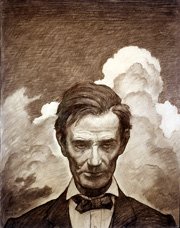
Gilead, Marilynne Robinson

This is a lovely, winsome, “restorative” kind of book. It was wonderful to share consciousness with the narrator of this book, who is such a gentle, well-intentioned individual that your heart wells up with pride that the human race could produce such a worthy specimen. Experiencing this book is like being given a warm coat when you’re freezing, or a soft bed when you’re exhausted, etc. -- it’s nourishing or strengthening somehow. The creation of this character is amazing -- it never for a minute feels untrue, and yet a paragon such as this could never exist. It’s several days since I finished Gilead, and I am only now struck by how artificially structured the story is (to create the contrasts of good and evil that the author is obviously interested in). It felt real and true throughout, and compelling. I want to read Housekeeping now, and also The Trail of the Lonesome Pine.


-- N.C. Wyeth, Portrait of Lincoln

Thursday, April 27, 2006

The Spirit Catches You and You Fall Down, Anne Fadiman

Fascinating. I would recommend this book highly to anyone. However, it bothered me throughout that Fadiman didn’t explain what she was doing or why; she simply provided a description of what appeared to be an investigation of some kind. This was especially odd since she offered extraneous personal details of other kinds to animate her scenes. But she never said to the reader or the interviewees: “I’m trying to find out more about Hmong culture” or “I’m a professor of medicine investigating what went wrong at this hospital” or “I’m a human rights lawyer following up on a complaint,” etc., all of which she could have been doing.


-- Hmong embroidery (from a private collection)