Thursday, September 13, 2007
The Comedy Thesaurus: 3,241 Quips, Quotes, and Smartass Remarks, Judy Brown
(September 11) All summer I've been toiling through The Success Principles, apparently becoming a slower and slower reader every time I open the book. However, I'm determined to finish it -- I'm not letting myself read any other book till I do, the sole exception being to dip occasionally into The Comedy Thesaurus, which Eileen gave us for our anniversary last year. I've dipped into it so often I've actually finished this 446-page "treasury" ahead of The Success Principles.
It's a great read -- obviously -- it's a compilation of the wittiest quips made by the world's best English-speaking comedians. Judy Brown's contribution to this money-maker is the arrangement of the clever remarks into encyclopedia-type categories, like "Clowns," "Divorce," "Life," "Soap," etc., and subcategories, like "Doctors, Questionable Practices" and "Doctors, Waiting Rooms." The categories exist mostly to have headings to break up the text. Whatever. The jokes are still funny.
The comedians who surprise me into laughing out loud most consistently, time after time, are Steven Wright and Emo Philips, and to a lesser degree (because there isn't as much of them in this collection) Richard Lewis, Gary Shandling and Judy Tenuta.
Some of my favourites:
Emo Philips:
I got into a fight one time with a really big guy, and he said, "I'm going to mop the floor with your face." I said, "You'll be sorry." He said, "Oh yeah? Why?" I said, "Well, you won't be able to get into corners very well."
What do you give a kid with seven fingers on one hand? Firecrackers.
When it comes to my health, I think of my body as a temple. Or at least a moderately well-managed Presbyterian Youth Centre.
I've learned about women the hard way: through books.
Steven Wright:
I stayed up one night playing poker with tarot cards. I got a full house and four people died.
Is "tired old cliché" one?
I wear my heart on my sleeve. I wear my liver on my pant leg.
I put instant coffee into the microwave. I almost went back in time.
I was arrested for selling illegal-size paper.
I got food poisoning today. I don't know when I'll use it.
Why is the alphabet in that order? Is it because of the song?
I went into a general store. They wouldn't let me buy anything specifically.
Gary Shandling:
My friends tell me I have an intimacy problem. But they don't really know me.
I grew up in Tucson, Arizona, where it's 120 degrees in the summer. One day our dog burst into flames. We thought we were going to have to start a backfire on the cat.
I got a jaywalking ticket, which is the dumbest ticket of all. I said, "Is this going to go on my record, or can I go to Walking School and have this taken off?"
Judy Tenuta:
I majored in nursing. I had to drop it. I ran out of milk.
My mother said, "You won't amount to anything because you procrastinate." I said, "Just wait."
How many of you ever started dating someone because you were too lazy to commit suicide?
Wednesday, August 01, 2007
Harry Potter and the Deathly Hallows, J.K. Rowling
I’m impressed that Rowling was able to keep each new book true to the general structure and pacing of the first one, and yet amp up the drama each time out. She rose to the challenge again this time and created quite the rollercoaster ride -- doubly impressive, given that she could basically just phone it in by now if she wanted to.
I had successfully avoided hearing about the ending in advance, so I was able to thrill to every cliffhanger and climactic moment Rowling threw at us, not sure what she would dare to do. But the ending was exactly what I wanted all along, and what readers of the first six books should expect. Deathly Hallows is a very generous and respectful farewell to the series.
Sunday, June 24, 2007
The Wild Trees: A Story of Passion and Daring, Richard Preston
The fall of Telperion [a redwood around 360 feet tall] had created a swath of devastation in the forest. Telperion was nearly as large as the Dyerville Giant. It had smashed a smaller redwood to pieces when it fell, creating a debris field that extended in all directions. The root mass of Telperion extended about thirty feet into the air. Its prone trunk was sixteen feet in diameter -- almost three times the height of their heads as they looked up at it. Shattered branches and small exploded trees and great chunks and splinters of redwood had been flung around the hulk of the tree. Blobs of soil ranging in size from baseballs to basketballs had been thrown up to thirty yards when Telperion smacked into the ground.but the descriptions of the life cycles and “behaviours” of giant redwoods, sequoias and Douglas firs are equally spellbinding.
“The mud splash when Telperion hit the ground must have been simply awesome,” [canopy scientist Steve] Sillett said to me. “We could see the splash mark way up on the trunks of the trees all around.” The trunks surrounding the detonation zone were coated with soil sixty feet above the ground, like a bathtub ring.
For example, Preston and Steve Sillett climb an adjacent tree to get to the top of Kronos, another 360-foot redwood:
We dropped down into a maze of standing trunks of all sizes. It was an aerial grove of redwoods that rise out of a buttressed platform extending from the side of Kronos, the largest trunk complex growing from a limb that has yet been identified on a redwood. It was the Great Kronos Complex, otherwise known as Kronos Wood. It had twenty-two trunks in it, springing out of a huge mass that grew sideways from the tree’s main trunk. The platform extended for sixty feet out of the side of Kronos. The bigger “trees” in Kronos Wood were between eighty and a hundred feet tall and up to a yard and a half across at their bases.Who knew??
Nearby, in the same grove:
Rhea had a double top, with twin trunks, and there was a garden between them. Rhea Garden was a deep pocket of soil that had become established near the top of the tree. The pocket was filled with plants, mosses and lichens. It was like a tiny Japanese garden, and it was probably as old as the Muromachi tea gardens of Kyoto. It was built up of layers of earth that had drifted into the tree.The descriptions of climbing techniques and of the people who climb these trees and study them are also interesting, but the way Preston presents the real-life redwood experts is a bit off-putting. He seems desperate to make his book dramatic – as if the science about these amazing trees would not be enough to make the book interesting. He provides too much weird detail about the biologists’ and daredevils’ lives, and doles it out in small vignettes that are held breathlessly suspended while we go through a round of tree observation. It’s forced and creaky. The tree lovers’ lives are only mildly interesting beyond their obsessions with giant trees. (This desperate dressing-up is foreshadowed in the title, I suppose: “A Story of Passion and Daring” = “Far More Exciting Than It Might Sound.”)
Preston also “steals” all the climbers’ best stories and tells them in the third person, as if he were there.
There are some amazing climbing stories, though. One of them made my blood freeze in my veins.
Saturday, June 02, 2007
The Comfort of Strangers, Ian McEwan
Having read only Atonement and Enduring Love, I didn’t realize McEwan was well known as a writer of the macabre. I see now that Enduring Love has a creep factor, but, when I was reading it, it just seemed to be about the vagaries of perception, like Atonement, with maybe just a little extra psycho twist to it.
Now that I look up media reviews, I see that the echoes of Poe / Pinter / Kafka are taken for granted in McEwan: “McEwan, that master of the taciturn macabre…” (Observer); “In the U.K., … he's long been dubbed Ian Macabre” (Salon); “His gift for the cold and scary is well established, too: among the critical praise that festoons his book jackets, the word 'macabre' crops up more than once” (New York Review of Books).
So I was obviously missing a big piece of the McEwan picture and this Goth tendency has come as a nasty surprise. I was also disappointed once again by lapses in coherence such as I saw in Atonement and Enduring Love. Richard P. Brickner summed it up perfectly in the New York Times:
The book, as it develops, requires the reader to accept a questionably large amount of innocence and acquiescence in Colin and Mary, and what almost seems like a careless overdose of perversity in Robert and Caroline. On the literal level, while not actually unbelievable, ''The Comfort of Strangers'' is hard to go along with at every moment.Brickner goes on to say that all this is forgivable: “As a nightmare, however, it is convincing and clinging. Its details are so imaginative and precise as to be a source of delight,” but I'm really offended by the lack of artistic harmony. It’s the difference between literature and vividly told newspaper stories. There’s nothing in all of The Comfort of Strangers to suggest that Colin and Mary are subconsciously looking for the kind of experience they get, or that they deserve it because of blindness or recklessness on their part, nor any forewarning whatsoever, so the ending just seems sort of random, and cheap, even.
Altogether, I’m put off binging any further on McEwan books.
Monday, May 28, 2007
Taft, Ann Patchett
This one is about a black man (and told from his point of view) whose jazz-joint life in Memphis is turned completely upside down by two white teenagers from hick-town Tennessee. The notion that such characters would get thrown together and behave in this way is, in itself, a kind of unbelievable premise, and I’m also never convinced that Patchett is presenting me with the consciousness of either a man or a black person. Though, how would I know, lol? Still, there’s a lot that’s familiarly white middle-class about the way the narrator and other characters think and speak.
But everyone’s quite likable, no one’s a strange drifter, and there’s a charm in Patchett’s attention to domestic details that I find engaging in this and all these books. It’s about the only thing that Bel Canto has in common with these other books – except that, in Bel Canto, it is a hundred times more successful: it is totally enthralling for its own sake, not to mention pivotal to the action and characterization. (I’m thinking of the Vice-President’s concern for everyone’s comfort, the terrorists learning to garden, the conceiving of how 120 people would live together in one room for four months.) On top of this, Bel Canto has a riveting premise and characters that are various and unforgettable. Bel Canto is light years ahead of the other three in terms of creating an imaginative reality that is convincing and spellbinding. It’s as though it was written by a completely different writer than the author of The Magician’s Assistant, The Patron Saint of Liars and Taft.
Thursday, May 10, 2007
Enduring Love, Ian McEwan
(May 9) I really enjoyed Atonement and a member of BookCel said that Enduring Love was as good if not better, so I grabbed it while I was waiting for Taft to show up at the library.
It is very good. McEwan is a master at presenting the defining moment of a life-altering event. He dangles it before your eyes in advance, thoroughly details how much it changed everything for the unsuspecting character(s), then slowly, slowly builds up to it, creating, of course, all kinds of suspense, then plays out the moment itself in excruciatingly slow motion. I find it effective, although this is only my second McEwan book... it could wear thin. But I do agree that, in real life, major things happen in minor moments.
Also well done and very clever: you can’t be absolutely sure for the longest time whether the first-person narrator, Joe Rose, is reliable. Is he really being stalked, or did the episode with the hot-air balloon unhinge him?
Unfortunately, McEwan has to compromise the integrity of one of the main characters in order to achieve the ambiguity – Joe’s spouse, Clarissa, has to pooh-pooh Joe’s anxieties right from the beginning in order to prompt the reader’s suspicions, and this just makes her totally unlikable in the end, even though she is painted as a womanly ideal throughout by Joe and everyone she meets. It’s fine that the police don’t believe Joe at first, and that he himself sounds sort of manic at various points in his narrative, but it’s cheating to have the allegedly loving spouse doubt him from the beginning. Why couldn’t she have believed him at first, and become exasperated and skeptical later on?
It’s like Briony in Atonement, who destroys an innocent person’s life for the sake of a naïve notion, and who believes in the end, I think wrongly, that the rest of the activities of her life atoned for the damage she did. These are two instances of deplorable behaviour/ethics in an otherwise sympathetic character. But, of course, that whole story depended on Briony doing what she did. In Enduring Love, in the same way, the drama depends on a woman behaving in an inexplicable way.
It’s a bit unsettling to be asked to overlook vagueness in major characters’ motivations. Still, these were both gripping stories. McEwan can really work it if you’re willing to grant him the premise.
Friday, May 04, 2007
The Patron Saint of Liars, Ann Patchett
(May 2) I liked this better than The Magician’s Assistant, in that it had much more of the ambiance of Bel Canto, which I loved, but it is nonetheless much more like The Magician’s Assistant than Bel Canto, alas.
It’s another one of those early-Kingsolver-style sagas about a female loner who abandons her life in one culture to go and live in a completely foreign one (both cultures are American in this case and in The Magician’s Assistant, and in at least two Kingsolvers). What’s worse, the central character is a blank drifter, like the main characters in Housekeeping -- peaceful sociopaths à la Martha Stout. I don’t see the fascination with these characters.
Still, I was surprised to learn afterwards that The Patron Saint of Liars (1992) is actually older than The Magician’s Assistant (1997) -- it had some of the magical atmosphere of Bel Canto (2001), and thus seemed nearer to it chronologically than that ironically unmagical Magician’s Assistant. Also, it was likable for providing some powerful insights into mother-daughter and, really, all female relationships.
Monday, April 23, 2007
The Magician's Assistant, Ann Patchett
(April 22) Underwhelming. I picked this up because I enjoyed Bel Canto so much. It can barely hold a candle to it, but it wasn’t as terribly disappointing as Housekeeping was after Gilead.
It reminded me of Barbara Kingsolver’s lesser works: an impossibly beautiful woman, a genius and a loner, suffers a life-altering loss, travels to a foreign part of the U.S. and faces all kinds of truths about herself. Ho hum. I find these hard to believe at the best of times – the heroines never seem to do too much before everyone is eating out of their hands and acknowledging their intellectual superiority – but this version is particularly incredible because the beautiful genius loner woman who travels to Nebraska is supposed to be a magician’s assistant who was in love with a gay man for 20 years, and there is nothing about Sabine Parsifal that is convincing as either a magician’s assistant or a sexual misfit.
There is a little bit of Fargo shock in this novel but it’s not enough to lift it out of apprentice-novelist territory.
Thursday, April 12, 2007
Don't Shoot the Dog, Karen Pryor
(April 11) Very interesting. I’m a big fan of the animal world anyway, but this book had come up in discussions about human behaviour, and reminded me of a New York Times story I read last summer that was eye-opening: “What Shamu Taught Me About a Good Marriage,” by Amy Sutherland, so Don’t Shoot the Dog was doubly interesting to me. And it was rewarding reading on both topics.
Yep, I’ll be getting a clicker.
Charming excerpt from Don’t Shoot the Dog:
Shanti [an elephant] quickly learned to fetch the Frisbee to me in return for a toot on the whistle and snack from the bucket. She also quickly learned to stand just a little bit farther away each time so I had to reach farther in for the Frisbee. When I didn't fall for that, she whopped me on the arm. When Jim and I both yelled at her for that (a sign of disapproval, which elephants respect), she started fetching nicely but pretended she'd forgotten how to pick up carrots. It took her a full minute, feeling the carrot in my hand with her trunk, while looking meaningfully into my bucket, to get me to understand that she preferred the apples and sweet potatoes that were also in there.
When I proved to be intelligent and biddable in this matter and started giving her the preferred reinforcers, she immediately used the same technique -- feeling with the trunk tip while making meaningful glances and eye contact -- to try to get me to open the padlock on her cage. Elephants are not just a little bit smart; elephants are eerily smart.
Species temperament shows up in many, many species in a shaping session. When I inadvertently failed to reinforce a hyena, instead of getting mad or quitting, it turned on the charm, sitting down in front of me, grinning and chuckling like a fur-covered Johnny Carson. In shaping a wolf to go around a bush in its yard, I made the same mistake, failing to reinforce it when I should have; the wolf looked over its shoulder, made eye contact with a long, thoughtful stare, then ran on, right around the bush, earning all the kibble I had in my pocket; it had sized up the situation, perhaps deciding that I was still in the game since I was still watching, and it had taken a chance and guessed at what would work. Big risk takers, wolves. If hyenas are comedians, wolves are Vikings.
Sometimes the animals understand reinforcement perfectly. Melanie Bond, in charge of the National Zoo's great apes, had started reinforcing Ham, the chimpanzee, for various behaviors. One morning he was accumulating his food rather than eating it, with the intention, Melanie supposed, of eating outdoors. When Ham saw that at last Melanie was going over to open the door and let him outside, he knew what to do: He handed her a stalk of celery.
Tuesday, March 20, 2007
Persuasion, Jane Austen
(March 18) I read Persuasion all at once over the weekend. It was a wonderful way to spend a weekend. I miss it now and would like to spend another couple of days with that set of characters and their scrupulous ways.
I thought I must have read Persuasion before because I am such a big Austen fan, but it wasn’t familiar. That is, the plot was familiar because it has many of the elements of a typical Austen plot; but I didn’t recall any of the little idiosyncrasies of the story, and I’m sure I would have remembered the comically vain father, Sir Walter, the emo suitor, Captain Benwick, and the spoiled sister, Mary, at the very least. They are amazing.
The heroine, Anne, is preternaturally wise and kind and virtuous, as is the hero, Captain Wentworth, but they aren’t cloying or tiresome; rather, they’re heartening somehow. Persuasion presents so many selfish and heartless people that Anne and Captain Wentworth are a contrast and a reprieve, and you want to cheer them on. In fact, I was struck by how a lot of the older people, the father, the older sister, the Dowager Viscountess, and even Lady Russell sometimes, are such poor role models. Austen is scornful of both the upper classes and the generation ahead of the heroine's in this novel.
However, though Persuasion is full of broad caricatures and grand passions, the charm of the novel is in the quietness and subtleness of the main action (the reconciliation of Anne and Captain Wentworth). So much hangs on so little – a look, a gesture, a tone of voice. The refinement actually supplies the most exquisite suspense.
Tuesday, March 06, 2007
The Amateur Emigrant, Robert Louis Stevenson

(March 4) It took me a long time to read this very short book -- it was interesting, but it didn't grab me by the lapels.
I usually enjoy historical journals -- it can be like time-travelling, especially when the writers go into the humble details of daily life -- there is always some food group or item of apparel or social custom that is bizarre and fascinating. I found Pepys's diary and L.M. Montgomery's journals, for example, real page-turners.
There was some element of the exotic in The Amateur Emigrant, but because Stevenson was doing something that was itself exotic at the time, it’s hard to tell if, when he is reporting on meals, entertainment and so on, it’s because they are ordinary or because they are out of the ordinary.
But, in the end, the details of life in the 1870s weren’t enough to make this chronicle fascinating to me. I think the style was a bit too ponderous: I had to read some passages four or five times to understand them; and I'm still not sure I understand some, such as this:
I have known men do hard literary work all morning, and then undergo quite as much physical fatigue by way of relief as satisfied this powerful frontiersman for the day. He, at least, like all the educated class, did so much homage to industry as to persuade himself he was industrious. But the average mechanic recognises his idleness with effrontery; he has even, as I am told, organised it.
The ponderousness and the sententiousness are surprising in the writer of Treasure Island and Dr. Jekyll and Mr. Hyde (but I haven’t read those in decades and may be selectively remembering only the action and suspense).
Tuesday, January 30, 2007
The Kite Runner, Khaled Hosseini
(January 27) Liked it a lot.
I realize that Hosseini’s narrator, Amir, has to be a coward for the story to work, but he is a terrible, terrible coward, and I find it hard to like him. It’s also hard to believe that such a coward ever becomes a good writer. How can you have anything worth saying about life if your first and only instinct is to protect yourself from it?
Thursday, January 18, 2007
Atonement, Ian McEwan
Gian Lorenzo Bernini, Triton Fountain(January 15) Really, really liked this.
Sunday, December 31, 2006
The Lost Salt Gift of Blood, Alistair MacLeod
Arthur Lismer, Igonish Dock, Cape Breton(December 27)
Bel Canto, Ann Patchett
Heather Cooper, from Carnaval Perpetuel??(December 26) Loved it.
I cannot encapsulate Bel Canto better than the New York magazine reviewer who called it a “dreamlike fable in which the impulses toward beauty and love are shown to be as irrepressible as the instincts for violence and destruction.”
Wednesday, November 29, 2006
Wedding Song, Naguib Mahfouz (translated by Olive E. Kenney)
Sesheps, The Great Sphinx of GizaOf course, what "really" happened is what each character experienced; there is no single point of view that does not have its blind spots.
"Wedding Song" is the name of a theatrical play that affects all the characters, and it is also a play on words that has meaning for Cairenes (I think). But, to me, the title reflects the fact that the four points of view are all driven by the characters' first true loves -- or, rather, by the subsequent disillusionment, disappointment, self-delusion and (in the case of the fourth and happiest relationship) death that resulted from the few happy moments of exhilarating love -- and that these love-graphs shape everything the characters see and do and believe. There are four different "wedding songs" here: each one starts beautifully but becomes a dirge in the end.
I love how the same conversations are revisited from each point of view (not always what you get in murder mysteries or narratives that feature rehashes (like The Woman in White, e.g.)). It is amazing the nuances that can be brought to the same set of words by four different people.
Mahfouz paints a portrait of Cairenes as people who are extremely sensitive to "corruption" -- they vehemently despise vices such as drinking, gambling and extramarital sex, but they are ineluctably drawn to them all the same. They are heroes who believe themselves villains, and they are utterly charming.
Wednesday, November 22, 2006
Jonathan Strange and Mr Norrell, Susanna Clarke
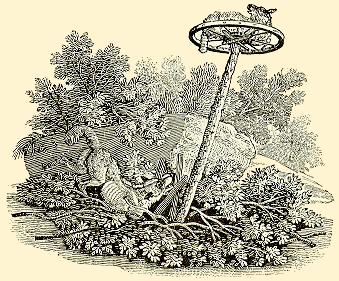
Thomas Bewick, The Wolf TrapI thought she did very well throughout with scenic description, and the characters were vivid. The magic element was interesting and inventive, but I wouldn't say JSMN is "Harry Potter for adults" as a lot of reviews have; there's still something goofy and Mother Goose-ish about it all (and I don't know what "Harry Potter for adults" is supposed to mean, anyway -- I, an adult, love the Potter books).
Editing related: Susanna Clarke is the most comma-free author I've read in a long, long time (or "long long time," as she would have it). At first this unkemptness grated on me, but it's amazing what you can get used to after 200 or 300 (eventually 800) pages. Comma, shmomma!
Saturday, October 28, 2006
Three Men in a Boat, Jerome K. Jerome
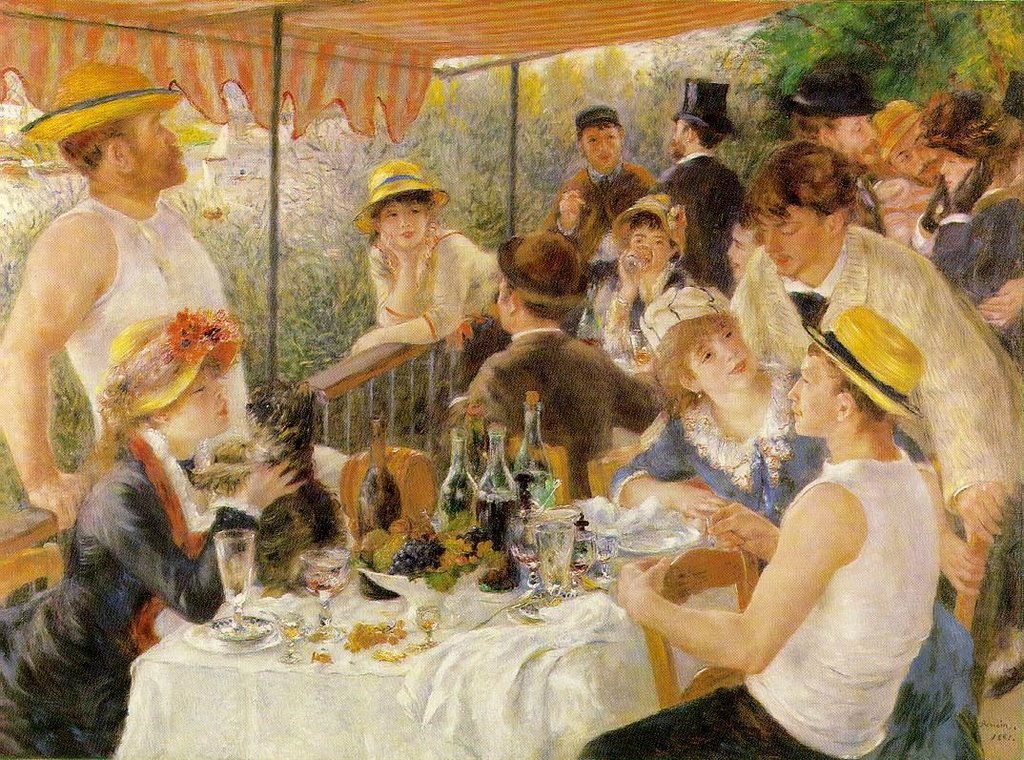
Pierre-Auguste Renoir, Luncheon of the Boating Party(October 26) I really liked Three Men in a Boat – it’s the buddy movie of its day – the Seinfeld or Mary Tyler Moore Show of the 1880s. It’s very funny. The story is nominally about one trip up the Thames in a rowboat undertaken by three young urban professionals, but this particular trip is really just the backdrop for a series of comic monologues about other boat trips and adventures and about life in general, à la George Carlin or Dave Barry. As the friends get ready for the excursion, for example, J., the narrator, pauses to lampoon weather forecasting and barometers: Then there are those new style of barometers, the long straight ones. I never can make head or tail of those. There is one side for 10 a.m. yesterday, and one side for 10 a.m. to-day; but you can't always get there as early as ten, you know. It rises or falls for rain and fine, with much or less wind, and one end is "Nly" and the other "Ely" (what's Ely got to do with it?), and if you tap it, it doesn't tell you anything. And you've got to correct it to sea-level, and reduce it to Fahrenheit, and even then I don't know the answer. The book is fun also because of the sensation of travelling back in time 120 years – paid work is done by children, people move their bathtubs around, a complete supper can be bacon and a jam tart, young men share single beds matter-of-factly. Spookily at one point, J. reverses the time-travel effect by making fun of the fashion of collecting antique china: Will the prized treasures of to-day always be the cheap trifles of the day before? Will rows of our willow-pattern dinner-plates be ranged above the chimneypieces of the great in the years 2000 and odd? Well, yes, they will! It was surprising that interspersed among the funny anecdotes and clever observations are serious little flights of poetic fancy that occasionally verge on the mawkish. I was struck by this one, though: And yet it seems so full of comfort and of strength, the night. In its great presence, our small sorrows creep away, ashamed. The day has been so full of fret and care, and our hearts have been so full of evil and of bitter thoughts, and the world has seemed so hard and wrong to us. Then Night, like some great loving mother, gently lays her hand upon our fevered head, and turns our little tear-stained faces up to hers, and smiles; and, though she does not speak, we know what she would say, and lay our hot flushed cheek against her bosom, and the pain is gone.
Tuesday, October 03, 2006
Empire Falls, Richard Russo
I can see why Irving and Russo would be compared -- their novels have many broad characteristics in common (bearing in mind that I'm basing my knowledge of Russo entirely on Empire Falls): there's a motley crew of likable characters, modern New Englanders, who are trying to carry out plain-vanilla lives as best they can while something evil and frightening looms in the background. Despite the dark clouds on the horizon, there's a charming and humorous passage on every page.
But I would say Irving and Russo are fundamentally very different. Or, perhaps, what I think of as "Irving" is a very specific quirkiness in the point of view and in the mapping out of the tale that Russo just doesn't have. Irving is a step away from his characters -- you can hear him lovingly puppet-mastering above the fray. Russo (like many writers) is much closer to his characters, more invisible as a narrator. Irving is also eccentric in the way he tells his characters' stories, often taking up and developing topics and side-stories that never get returned to in the course of the über-story -- which is a way of disarming professional readers, who are used to taking note of seemingly random details, confident they'll later on be woven neatly into the climax of the book.
In some ways, Irving is an "unprofessional" novelist.
Russo is professional -- in both the good and bad senses. Empire Falls is very neatly plotted: all the disparate issues affecting individual characters are brought to bear on the novel's climax, which is a series of surprising, and in some cases shocking, revelations about individual characters' secret intentions. The climax of Empire Falls is quite dramatic, in fact -- way more than any Irving novel ever is.
But Empire Falls is also a bit conventional. You kind of know right off the bat how the chips should fall, and they do fall that way. It's a TV-generation quality. Irving definitely doesn't have that quality.
The best thing about Russo is the witty little turns of phrase he often uses to capture a detail in a scene or the mood of a character. He's in the Dave Barry or Bill Bryson schools of humour, only subtler.
Overarching observation: with The Cider House Rules and Empire Falls, I have spent the month of September in Maine.

Thursday, September 21, 2006
The Cider House Rules, John Irving
What is that "way"? Why do I like Irving? Roger Ebert said of the movie version of The Cider House Rules that it "is often absorbing or enchanting in its parts." That is certainly true of all the books. There are always several totally enchanting characters, who seem to embody various combinations of my own best qualities, lol. The events that befall these characters are sometimes surreal, but charmingly so. The threat of something awful about to happen often hangs in the air around Irving characters, but that only compels me to read on. Perhaps the really attractive thing in Irving's books is how much groups of characters love one another. There are weird and hateful characters in every Irving novel, but there is always a core group of people whose love for one another is very affectingly portrayed.
Ebert also said of the movie version of The Cider House Rules, "The story touches many themes, lingers with some of them, moves on and arrives at nowhere in particular. It's not a story so much as a reverie about possible stories." This is true of all the Irving I've read, and I like it fine.
But, in fact, there is a very poignantly painful question posed by this novel: "How do you protect the one(s) you love from how much you're going to hurt them?"
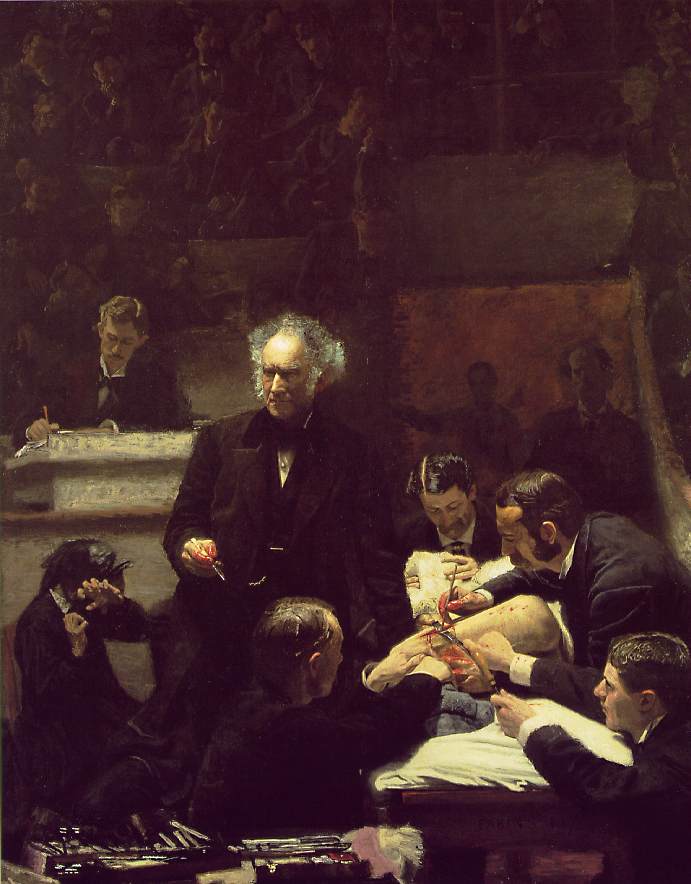
When I started reading The Cider House Rules, Thomas Eakins' The Gross Clinic came to me as the image. It was startling to see, further into the book, how appropriate this was -- knives are a big part of this novel, only beginning with scalpels.