Monday, February 18, 2008

The Careful Use of Compliments, Alexander McCall Smith

William Crozier, Edinburgh (from Salisbury Crags)

(February 14) We learn even more about modern Scottish painters in this Isabel Dalhousie and also travel out into the rural parts of Scotland and the isles a great deal (in contrast to my image choice above). This time the nominal "mystery" is a potential art forgery, and once again McCall Smith provides an interesting and unexpected solution. However, he didn’t surprise me with the final twist in the Isabel-Jamie-Cat love triangle.

Or is he just leading me on?

Sunday, February 10, 2008

Friends, Lovers, Chocolate, Alexander McCall Smith

William Allan, The Murder of David Rizzio

(February 9) This one has the most shamelessly chick-lit title in what is definitely a series for women readers, and there is some very feminine swooning over chocolate and men in it, so it is a bit soap-opera-y. But Friends, Lovers, Chocolate does redeem itself by once again featuring this highly original definition of mystery McCall Smith has played with in the series, and it does so by way of some really interesting questions, namely, can a heart recipient see the donor's murderer (if indeed the donor was murdered) and what is the importance of being able to give thanks for an important gift?

As in The Right Attitude to Rain and The Sunday Philosophy Club, we learn a great deal about the City of Edinburgh (particularly in June) and about 20th-century Scottish artists, and in this one we go into a bit of Scottish history as well. The famous story of Mary Queen of Scots being unable to prevent the death of Rizzio right in front of her eyes is a counterpart both to the fate of the heart donor and to Isabel's indecision about taking on a Latin lover. Quirky.

Tuesday, February 05, 2008

The Sunday Philosophy Club, Alexander McCall Smith

William Crosbie, Dum Vivimus Vivamus

(February 4) So, just as rain is a topic mentioned only once, very casually, in The Right Attitude to Rain, a Sunday philosophy club is just a throwaway reference in The Sunday Philosophy Club. I’m starting to get the charm of these books.

There is at least a mysterious death in this installment, which explains how the series must have won its berth in the "mystery" category. However, Isabel doesn't "solve" the puzzle for the usual reasons sleuths solve mysteries -- and she doesn't do anything with the solution once she has it --; it's a very anti-mystery mystery. Her response to the death is an ethical question for Isabel, first and foremost, and for the bulk of the book she dithers away over other small, domestic, ethical issues, just as in The Right Attitude to Rain.

There is so little action! People are met, beverages are drunk, food is eaten, routines are gone through. Still, there's something really pleasant about the tone and pace of these books. Also, both Sunday Philosophy Club and Right Attitude to Rain have ended with a completely surprising twist, for which McCall Smith deserves a lot of credit.

Sunday, February 03, 2008

The Right Attitude to Rain, Alexander McCall Smith

David Gauld, Music

(February 2) Aunt Lois gave me this since she had an extra copy and we’d been talking about Alexander McCall Smith on Christmas Day. I was glad to get it because I loved the first five books of the No. 1 Ladies’ Detective Agency, and I’d heard various people (including Aunt Lois)
say they liked the Isabel Dalhousie series as much, if not more, than they liked the Botswana books.

But, at first blush, this book baffled me. I expected it to be different from the Botswana books, but I wasn’t prepared for it being different in the way it was. The narrative voice is all brisk and conventional, instead of tender and cheeky as it is in the Botswana books; the main character, Isabel, is not presented with the same kind of cozy familiarity as Precious is; and, moreover, Isabel is, basically, borderline neurotic, constantly and exhaustively analyzing everything that happens and every little choice she has to make in terms of their ethical ramifications. It’s the very definition of Zen mindfulness. In fact, an hour reading this book is more like an hour spent doing mindful meditation than anything else.

On top of this, nothing really happens, and Isabel is not really a sleuth; she’s a bit curious about people and their motivations, but that’s it. There’s very little discussion of rain, even. It seemed flat and formal, like the David Gauld painting above, at first, and I didn’t think I’d end up pursuing the series.

But by the end of the book, the pleasant tone and pace had won me over a bit. I was wondering if I had been wrong to read the third of a four-book series first, and willing to give another title in the series a go.

Well, four books later, I can say that it was definitely a mistake to read The Right Attitude to Rain first. Now I know that A GREAT DEAL happens in The Right Attitude to Rain and that I spoiled my potentially much greater enjoyment of it by reading it out of order. Also, I now appreciate Isabel’s philosophical conundrums as “the mysteries” she solves, and have to concede that her thorough working out of her ethical duties is a quite acceptable kind of sleuthiness.

Thursday, January 31, 2008

The Amber Spyglass, Philip Pullman


William Blake, The Ancient of Days

(January 29) I loved Book I, was able to coast happily through Book II on that love, but found Book III a bit of a chore to get through. In trying to resolve all the giant questions and epic struggles set up in the first two books, The Amber Spyglass wanders all over the place and, I think, becomes completely incoherent at times.

Also, it goes all 17th and 18th Century on our ass. I saw the Blake allusions even before Pullman came right out and called the God figure “the ancient of days,” and it’s impossible to ignore the homage to Milton at this point (I didn’t see it in the earlier books but “His Dark Materials” left little doubt it was coming).

I’m not a Milton fan, so the grandioseness, artificiality and über-Catholicism of Book III killed my buzz; but there are plain old mechanical problems as well. It’s almost as though Pullman ran out of time and/or space -- he set up such a leisurely pace in Book I that it seems he’s cramming too much half-worked-out material into Books II and III.

I was so disappointed with what happened to Mrs. Coulter. I was also not sure how Lyra, Will and Mary represented Eve, Adam and the Garden of Eden’s serpent, as advertised (and not interested enough to reread and work that out).

On the other hand, I still enjoyed Pullman's imagination and inventions for their own sake. The faux anthropological studies of the mulefa and the Gallivespians, for example, are enchanting.

Monday, January 07, 2008

The Subtle Knife, Philip Pullman

(December 28) This is a respectable continuation of The Golden Compass story -- not a disappointing continuation, because Pullman's amazing imagination is so enjoyable, but not a dream-fulfilling continuation either, because now the story is getting a little overcomplicated, and Lyra and her world are no longer prominent (in fact, we are in our world, ho hum).

This book introduces a new character -- a 12-year-old boy, Will -- and I found myself really not wanting to be interested in him since it would be disloyal to Lyra, lol. But Pullman managed to overcome my bias and is successful with Will, I think -- his courage is just as thrilling as Lyra's, and he's his own person, not just a male Lyra. I really liked him, and was entirely captivated with the function and role of the knife.

I began to see here in Book II why Lyra is so appealing in Book I: she has a lot of balls, like a boy, but is still girlish and girly (e.g., in her affection for Pan and her bedazzlement by Mrs. Coulter). Will, in contrast, is tender and conscientious, very touchingly so, I thought, like a girl, and yet there was no doubt he is a boy. There are many satisfying little parallels in the two characters and in the ways the mystery looming around them draws them in, which make The Subtle Knife fun to read.

However, that über-story also starts to take itself very seriously, and wants to be an epic allegory now, rather than the localized little struggle it was in Book I. I find this less compelling. Also, it's hard to watch Lyra fade into a co-star role, sigh.
Michelangelo, David

Sunday, December 23, 2007

The Golden Compass, Philip Pullman

John Everett Millais, Portrait of a Girl (Sophie Gray)
(December 19) I was taken by surprise by this little fantasy and then was completely taken with it.

A young girl, Lyra Belacqua, in a world not quite ours, decides to investigate a mysterious new scientific discovery. She must trick and undermine a lot of evil-doers, and learns a great deal about her own abilities along the way.

I guess I expected something like Harry Potter, but it’s not like that at all -- it's not cheerful and wouldn't-it-be-fun-if -- it's so much darker and more adult in every way (even though the protagonist is 12 years old). In fact, it's shockingly dark sometimes -- Lyra's parents are frightening and the world she's in is cold and ruthless.

The whole book is imaginative and original, but the main character, Lyra, is a huge factor in its charm. What a creation! She makes all my other favourite girl heroes -- Alice, Anne Shirley, Jo March, Scout Finch -- seem like ninnies. Yet she's still completely credible, as a girl and as a point of view.

I loved how it slowly emerges that Lyra is in a parallel world. There is no doubt from the beginning, with the daemons, that this is fantasy, but you aren’t sure whether this is our world in the future, having "gone wrong," or some kind of shadow world, or what. Pullman lets it dawn upon you in layers, letting you "solve" little mysteries about what people are doing and saying on your own, rather than explaining everything in detail ahead of the action, as even Lord of the Rings does, which makes everything more cartoon-y (I think).

The Golden Compass is subtle and disarming, plus very suspenseful -- I could not wait to find out what Dust was, and what would happen to Asriel and Coulter, and so on. Fun stuff.

The Science of Getting Rich, Wallace D. Wattles

(December 9) This little book (if indeed it counts as a book -- it takes only an hour or two to read) is the Victorian businessman’s version of The Secret and The Success Principles.

Like its successors, The Science of Getting Rich says that to be successful you must: “believe” you are acquiring wealth and possessions; live as if you have wealth already; cultivate a grateful attitude; ignore all other issues in life except getting and enjoying wealth and accomplishments.

I like this Victorian version because it is Victorian -- the energetic tone and passion for productivity that are the hallmarks of a late 19th century sensibility are perfect for this subject. Wattles isn’t trying to be mystical or proprietary about this bizarre theory; he’s just trying to simplify it for ease of use (as Victorians liked to do).

He lays out the principles -- a Way of Being, he calls it -- straightforwardly and objectively, not passing any judgements on it nor offering any wild speculations on why it exists. He’s simply convinced this system works and believes it’s everyone’s moral and civic duty to try it.

Alphonse Mucha, Moët et Chandon Crémant Impérial

Friday, November 16, 2007

The Secret, Rhonda Byrne

Martin Sharp, Explosion
(November 15) Reviewing this book takes care of reviewing The Success Principles, because it’s the same book, just clothed differently. The premise in both is that we all have complete power over the events that occur in our lives and can acquire all the wealth and property we desire by locating that part of ourselves that is infinite and one with the universe and using it to attract goods and experiences. (And also by cultivating an attitude of gratitude, and by running mental tapes of the things and accomplishments you want in your head constantly (i.e., meditating).)

It’s certainly true that identifying this principle and writing a book about it will bring you success -- there are dozens of versions of them out there, all best-sellers, and I believe The Secret was an Oprah book. Jack Canfield’s The Success Principles is the professional businessman’s version of it; Barbara Sher’s Wishcraft: How to Get What You Really Want is the professional businesswoman and homemaker’s version; Sonia Choquette’s Your Heart's Desire is for the psychic New Age hippie crowd; Deepak Chopra’s The Seven Spiritual Laws Of Success is the mystical, ancient-wisdom, more-overtly-about-meditating version; James Redfield’s The Celestine Prophecy is for the adventure-fiction lover; etc.

Rhonda Byrne’s The Secret must be the busy young woman’s version, since it’s short, cuts to the chase, and provides quick, message-board-style testimonials to back up the “insights.” I believe she acknowledges William Walker Atkinson, but she saves you the trouble of wading through his 19th-century style.

It’s fun to read the forums about The Secret -- people are either passionately supportive or passionately contemptuous of it, and the vast majority are the latter. I think there is something repellent about the theory in this book and in all those others, something mercenary that makes people reject it without even wanting to try it. It’s counter-intuitive to the Protestant Work Ethic mentality of the western world, for sure.

But, true story: The moment I finished The Secret, I used the principle to try to get a parking spot at the library since I had to get the book back there within the next 15 minutes. One of the testimonial-providers in The Secret said he used it all the time to get parking spaces close to where he wanted to be, and nine times out of 10 got them. So I drove to the library visualizing a parking spot directly in front of the doors, and I believed I would get it. When I turned onto the library’s block, I laughed to myself, because every single spot on both sides of the street was taken up (which was completely bizarre at 8:50 p.m. on a Wednesday night, too). I rolled up slowly in front of the library with the intention of turning into a driveway and looping back around. At the exact moment I arrived in front, a car pulled out just ahead of me, leaving the most plum parking spot anyone could desire wide open.

Saturday, November 03, 2007

Run, Ann Patchett

Faith Ringgold, The American People Series #20: Die
(November 1) I looked hopefully to Run to deliver some of that Bel Canto magic since it's the first book Patchett's written since Bel Canto, but, alas, that was not quite to be. It's really likable, though. It starts out very promisingly indeed with a family story about a statue that goes back several generations and into "the old country" in a very charming magic-realism way... but then it turns into a story of family ties in a strangely interracial family that involves adoptions and a person who doesn't know who her real parents are: in other words, a blend of Taft and The Patron Saint of Liars. Again, as in Taft, the interracialism seems to be merely decorative and, again, as in The Patron Saint of Liars, the girl doesn’t seem to be affected either way by not knowing the identity of her real mother/father. Still, Patchett creates some really interesting patterns within the pieced-together family in this book. Odd touch: Run is sprinkled with passages from famous U.S. political speeches, justified as a “game” developed by the current generation of brothers. It undermines the willing suspension of disbelief every time it crops up.

Tuesday, October 23, 2007

Truth and Beauty: A Friendship, Ann Patchett

Norman Rockwell, Doctor and Doll
(October 21) Not what I expected at all. When I first heard about Truth and Beauty, it sounded controversial and exciting. There were boards full of angry readers ranting about Lucy Grealy's life (was she immoral or clinically ill?) and Patchett's entitlement to the story (was she a vulture, an enabler or a true friend?). Then, Clemson University alumni and parents objected to the assignment of this book as required first-year reading, because it was pornographic and encouraged a sordid lifestyle. Patchett said this perception had blindsided her: "if anything, the criticisms of the book had erred on the side of, 'It's too sweet, too gentle.'" Elsewhere, talking about Lucy, Patchett makes it sound as if their friendship was a long litany of difficult, drama-queen moments: "Lucy was hard, she was a challenge. And she pushed us all to our limits... sometimes to our most horrible."

So then I read Truth and Beauty, anticipating a roller-coaster ride of moral challenges, harrowing escapades, deep feeling and intimate glimpses of a fascinating person. It had none of these things. Grealy's life doesn't come across as particularly edgy or lurid, certainly not enough to provoke the passionate denouncements and defenses on the discussion boards. She just sort of slips into heroin use in the last two years of her life, but Patchett is so distant and disapproving at this stage that we don't see any of the actual destructiveness of the addiction. It's a symbolic Bad Thing.

Nor is the book pornographic in any way, and Patchett definitely does not encourage imitation of any of Lucy's racier activities, which are anyway only mildly racy. It's a complete mystery to me what the Clemson U protesters could have found offensive.

It's not sweet, either. It has what should be touching moments here and there, but Patchett never communicates any of what it was she loved about Grealy, even though she states many times that she did love her. I expected Patchett to rise to the challenge of explaining why limit-pushing Lucy was so beloved by so many people, but at best she makes Lucy sound like a quirky pet or doll and at worst she dwells on the behaviours that would make Lucy unappealing. (These amount to nothing more than irresponsibility with money and a habit of jumping unexpectedly into your arms or lap.)

Truth and Beauty is really mostly about Patchett, and about how "slow and steady wins the race," even though the hare steals all the best scenes. It's Patchett’s apology for being dull and stodgy -- she's claiming dull-and-stodgy kept Lucy alive.

So the title “Truth and Beauty” is really kind of vengeful, after all; it's not the reference to Keatsian transcendentalism it promises to be.

Sunday, October 14, 2007

Autobiography of a Face, Lucy Grealy

Pablo Picasso, Crying Head (V)
(September 27) I really liked this little book, for both the content -- for being allowed to gawk at the harrowing experiences of a young girl who spent her childhood undergoing brutal treatments for cancer and then the rest of her life horribly disfigured by it all -- and for the writing as well, which is as clear and light and easy as hearing oneself think. You wish you knew Lucy Grealy, feel bad for what she went through, are sorry she died, feel cheated of other writing she might have done.

I came to this book in a very roundabout way -- it is the companion-piece to Ann Patchett's Truth and Beauty, which was just being promoted when I was reading Bel Canto. I was certain I wanted to read only more fiction by Patchett, not a memoir -- and, in any case, Lucy Grealy sounded from the reviews like a fatiguing prima donna of a girl, pace her illness and disfigurement. I went ahead and read Patchett's three other novels, and was consequently, sadly, on the verge of losing all interest in her, when a BookCEL member pointed the group to a special series in The Atlantic on the controversy at Clemson University over Truth and Beauty. I read the interview of Patchett there, watched the video of her speech, listened to the NPR interview with Lucy Grealy, then finally bought the Atlantic fiction issue to read the essay "My Pornography" by Patchett. Lucy now was fascinating, charismatic, irresistible.

I now know from Autobiography of a Face and from the lengthy interview on NPR that she can't have been diva-like and over-the-top all the time -- Patchett must have deliberately exaggerated this; or else the stories she chooses to tell about Grealy in the Atlantic essay are focused on this unconsciously. But I am just about to read Truth and Beauty (sorry, Success Principles; it’s just not working out between us), and I suspect I’ll see that Grealy romanticized herself as an adult in Autobiography of a Face. You know she wasn’t 100 per cent drama queen nor could she have been 100 per cent Beth March in Little Women, but you can also sense the romanticizing filter in the book itself. The detailed scenes Grealy recreates from her childhood have the unexpectedness of real life, but her quick trip through her adult years offers details that mostly sound like literature -- those dull thunks of poetic justice, irony, "ain’t it true?", etc. -- the careful hand of the artisan. Even the expression toward the end gives me the feeling of the smoke-machine being wheeled out. I don’t hold it against her -- it was her own life she had to go on living, after all, once she finished writing the book (and scored the cash). But I don't feel like I'll have met her real adult self till Truth and Beauty finally wends its way to the Dundas branch of the Hamilton Public Library.

And I do have a private theory that Patchett might have caricatured / infantilized Grealy a little bit out of jealousy. I think, on the basis of one little book, that Lucy might have been the better writer. They are similar writers -- there's a whole generation using this voice, actually -- but Patchett is ever so slightly... sedate. Some would call it "polished."

By way of contrast here is a small sample of Lucy that is, to me, transporting:
The third life took place after school, and all day during the summer, when I went to my horse, Swinger, with whom I was conducting nothing less than a romantic relationship.

I knew his whole being. There was not one part of his body I could not touch, not one part of his personality I did not know at least as well as my own. When we went on long rides through the woods, I would tell him everything I knew and then explain why I loved him so much, why he was special, different from other horses, how I would take care of him for the rest of his life, never leave him or let anyone harm him. After the ride I would take him to graze in an empty field. I would lie down on his broad bare back and think I was the luckiest girl alive, his weight shifting beneath me as he moved toward the next bite of grass. Sometimes I took him to the stream and laughed as he pawed at the water, screaming in delight when he tried to lie down in it. Best of all was when I happened to find him lying down in his stall. Carefully, so as not to spook him, I’d creep in and lie down on top of his giant body, his great animal heat and breath rising up to swallow my own smaller heat and less substantial air.

Thursday, September 13, 2007

The Comedy Thesaurus: 3,241 Quips, Quotes, and Smartass Remarks, Judy Brown

Gerrit van Honthorst, Portrait of a Laughing Violinist

(September 11) All summer I've been toiling through The Success Principles, apparently becoming a slower and slower reader every time I open the book. However, I'm determined to finish it -- I'm not letting myself read any other book till I do, the sole exception being to dip occasionally into The Comedy Thesaurus, which Eileen gave us for our anniversary last year. I've dipped into it so often I've actually finished this 446-page "treasury" ahead of The Success Principles.

It's a great read -- obviously -- it's a compilation of the wittiest quips made by the world's best English-speaking comedians. Judy Brown's contribution to this money-maker is the arrangement of the clever remarks into encyclopedia-type categories, like "Clowns," "Divorce," "Life," "Soap," etc., and subcategories, like "Doctors, Questionable Practices" and "Doctors, Waiting Rooms." The categories exist mostly to have headings to break up the text. Whatever. The jokes are still funny.

The comedians who surprise me into laughing out loud most consistently, time after time, are Steven Wright and Emo Philips, and to a lesser degree (because there isn't as much of them in this collection) Richard Lewis, Gary Shandling and Judy Tenuta.

Some of my favourites:

Emo Philips:
I got into a fight one time with a really big guy, and he said, "I'm going to mop the floor with your face." I said, "You'll be sorry." He said, "Oh yeah? Why?" I said, "Well, you won't be able to get into corners very well."

What do you give a kid with seven fingers on one hand? Firecrackers.

When it comes to my health, I think of my body as a temple. Or at least a moderately well-managed Presbyterian Youth Centre.

I've learned about women the hard way: through books.

Steven Wright:
I stayed up one night playing poker with tarot cards. I got a full house and four people died.

Is "tired old cliché" one?

I wear my heart on my sleeve. I wear my liver on my pant leg.

I put instant coffee into the microwave. I almost went back in time.

I was arrested for selling illegal-size paper.

I got food poisoning today. I don't know when I'll use it.

Why is the alphabet in that order? Is it because of the song?

I went into a general store. They wouldn't let me buy anything specifically.

Gary Shandling:
My friends tell me I have an intimacy problem. But they don't really know me.

I grew up in Tucson, Arizona, where it's 120 degrees in the summer. One day our dog burst into flames. We thought we were going to have to start a backfire on the cat.

I got a jaywalking ticket, which is the dumbest ticket of all. I said, "Is this going to go on my record, or can I go to Walking School and have this taken off?"

Judy Tenuta:
I majored in nursing. I had to drop it. I ran out of milk.

My mother said, "You won't amount to anything because you procrastinate." I said, "Just wait."

How many of you ever started dating someone because you were too lazy to commit suicide?

Wednesday, August 01, 2007

Harry Potter and the Deathly Hallows, J.K. Rowling

Peter Carl Fabergé, Peacock Egg
(July 28) I really liked it. I think Rowling did a great job with this series. I was never disappointed by any of the installments.

I’m impressed that Rowling was able to keep each new book true to the general structure and pacing of the first one, and yet amp up the drama each time out. She rose to the challenge again this time and created quite the rollercoaster ride -- doubly impressive, given that she could basically just phone it in by now if she wanted to.

I had successfully avoided hearing about the ending in advance, so I was able to thrill to every cliffhanger and climactic moment Rowling threw at us, not sure what she would dare to do. But the ending was exactly what I wanted all along, and what readers of the first six books should expect. Deathly Hallows is a very generous and respectful farewell to the series.

Sunday, June 24, 2007

The Wild Trees: A Story of Passion and Daring, Richard Preston

Emily Carr, Deep in the Forest
(June 24) The information about redwoods and other trees is fascinating... astounding... unfathomable. Just in terms of the dimensions and sheer volumes of these trees the information is amazing:
The fall of Telperion [a redwood around 360 feet tall] had created a swath of devastation in the forest. Telperion was nearly as large as the Dyerville Giant. It had smashed a smaller redwood to pieces when it fell, creating a debris field that extended in all directions. The root mass of Telperion extended about thirty feet into the air. Its prone trunk was sixteen feet in diameter -- almost three times the height of their heads as they looked up at it. Shattered branches and small exploded trees and great chunks and splinters of redwood had been flung around the hulk of the tree. Blobs of soil ranging in size from baseballs to basketballs had been thrown up to thirty yards when Telperion smacked into the ground.

“The mud splash when Telperion hit the ground must have been simply awesome,” [canopy scientist Steve] Sillett said to me. “We could see the splash mark way up on the trunks of the trees all around.” The trunks surrounding the detonation zone were coated with soil sixty feet above the ground, like a bathtub ring.
but the descriptions of the life cycles and “behaviours” of giant redwoods, sequoias and Douglas firs are equally spellbinding.

For example, Preston and Steve Sillett climb an adjacent tree to get to the top of Kronos, another 360-foot redwood:
We dropped down into a maze of standing trunks of all sizes. It was an aerial grove of redwoods that rise out of a buttressed platform extending from the side of Kronos, the largest trunk complex growing from a limb that has yet been identified on a redwood. It was the Great Kronos Complex, otherwise known as Kronos Wood. It had twenty-two trunks in it, springing out of a huge mass that grew sideways from the tree’s main trunk. The platform extended for sixty feet out of the side of Kronos. The bigger “trees” in Kronos Wood were between eighty and a hundred feet tall and up to a yard and a half across at their bases.
Who knew??

Nearby, in the same grove:
Rhea had a double top, with twin trunks, and there was a garden between them. Rhea Garden was a deep pocket of soil that had become established near the top of the tree. The pocket was filled with plants, mosses and lichens. It was like a tiny Japanese garden, and it was probably as old as the Muromachi tea gardens of Kyoto. It was built up of layers of earth that had drifted into the tree.
The descriptions of climbing techniques and of the people who climb these trees and study them are also interesting, but the way Preston presents the real-life redwood experts is a bit off-putting. He seems desperate to make his book dramatic – as if the science about these amazing trees would not be enough to make the book interesting. He provides too much weird detail about the biologists’ and daredevils’ lives, and doles it out in small vignettes that are held breathlessly suspended while we go through a round of tree observation. It’s forced and creaky. The tree lovers’ lives are only mildly interesting beyond their obsessions with giant trees. (This desperate dressing-up is foreshadowed in the title, I suppose: “A Story of Passion and Daring” = “Far More Exciting Than It Might Sound.”)

Preston also “steals” all the climbers’ best stories and tells them in the third person, as if he were there.

There are some amazing climbing stories, though. One of them made my blood freeze in my veins.

Saturday, June 02, 2007

The Comfort of Strangers, Ian McEwan

Steven Klein, Stefano + Domenico "Dolce Vita"
(May 30) This is a take on an Edgar Allan Poe story, somewhat longer and totally modernized. (Specifically, it reminds me of “The Cask of Amontillado” -- they have slightly different plots, but they end similarly and create exactly the same eerie mood and creepy-Venetian atmosphere.) I kind of wish I’d known this going in -- I find it easier to stomach gruesome action when I’m expecting it.

Having read only Atonement and Enduring Love, I didn’t realize McEwan was well known as a writer of the macabre. I see now that Enduring Love has a creep factor, but, when I was reading it, it just seemed to be about the vagaries of perception, like Atonement, with maybe just a little extra psycho twist to it.

Now that I look up media reviews, I see that the echoes of Poe / Pinter / Kafka are taken for granted in McEwan: “McEwan, that master of the taciturn macabre…” (Observer); “In the U.K., … he's long been dubbed Ian Macabre” (Salon); “His gift for the cold and scary is well established, too: among the critical praise that festoons his book jackets, the word 'macabre' crops up more than once” (New York Review of Books).

So I was obviously missing a big piece of the McEwan picture and this Goth tendency has come as a nasty surprise. I was also disappointed once again by lapses in coherence such as I saw in Atonement and Enduring Love. Richard P. Brickner summed it up perfectly in the New York Times:
The book, as it develops, requires the reader to accept a questionably large amount of innocence and acquiescence in Colin and Mary, and what almost seems like a careless overdose of perversity in Robert and Caroline. On the literal level, while not actually unbelievable, ''The Comfort of Strangers'' is hard to go along with at every moment.
Brickner goes on to say that all this is forgivable: “As a nightmare, however, it is convincing and clinging. Its details are so imaginative and precise as to be a source of delight,” but I'm really offended by the lack of artistic harmony. It’s the difference between literature and vividly told newspaper stories. There’s nothing in all of The Comfort of Strangers to suggest that Colin and Mary are subconsciously looking for the kind of experience they get, or that they deserve it because of blindness or recklessness on their part, nor any forewarning whatsoever, so the ending just seems sort of random, and cheap, even.

Altogether, I’m put off binging any further on McEwan books.

Monday, May 28, 2007

Taft, Ann Patchett

Charles Alston, Family No. 1
(May 27, 2007) Taft was OK – readable, sweet-natured, and with something about it that I’ve liked in all the Patchett books I’ve read, but it’s not a book I could rave about. It was like Magician’s Assistant and Patron Saint of Liars in that way: I liked them enough to finish them, but I didn’t read them avidly nor lament their ending.

This one is about a black man (and told from his point of view) whose jazz-joint life in Memphis is turned completely upside down by two white teenagers from hick-town Tennessee. The notion that such characters would get thrown together and behave in this way is, in itself, a kind of unbelievable premise, and I’m also never convinced that Patchett is presenting me with the consciousness of either a man or a black person. Though, how would I know, lol? Still, there’s a lot that’s familiarly white middle-class about the way the narrator and other characters think and speak.

But everyone’s quite likable, no one’s a strange drifter, and there’s a charm in Patchett’s attention to domestic details that I find engaging in this and all these books. It’s about the only thing that Bel Canto has in common with these other books – except that, in Bel Canto, it is a hundred times more successful: it is totally enthralling for its own sake, not to mention pivotal to the action and characterization. (I’m thinking of the Vice-President’s concern for everyone’s comfort, the terrorists learning to garden, the conceiving of how 120 people would live together in one room for four months.) On top of this, Bel Canto has a riveting premise and characters that are various and unforgettable. Bel Canto is light years ahead of the other three in terms of creating an imaginative reality that is convincing and spellbinding. It’s as though it was written by a completely different writer than the author of The Magician’s Assistant, The Patron Saint of Liars and Taft.

Thursday, May 10, 2007

Enduring Love, Ian McEwan

René Magritte, The Son of Man

(May 9) I really enjoyed Atonement and a member of BookCel said that Enduring Love was as good if not better, so I grabbed it while I was waiting for Taft to show up at the library.

It is very good. McEwan is a master at presenting the defining moment of a life-altering event. He dangles it before your eyes in advance, thoroughly details how much it changed everything for the unsuspecting character(s), then slowly, slowly builds up to it, creating, of course, all kinds of suspense, then plays out the moment itself in excruciatingly slow motion. I find it effective, although this is only my second McEwan book... it could wear thin. But I do agree that, in real life, major things happen in minor moments.

Also well done and very clever: you can’t be absolutely sure for the longest time whether the first-person narrator, Joe Rose, is reliable. Is he really being stalked, or did the episode with the hot-air balloon unhinge him?

Unfortunately, McEwan has to compromise the integrity of one of the main characters in order to achieve the ambiguity – Joe’s spouse, Clarissa, has to pooh-pooh Joe’s anxieties right from the beginning in order to prompt the reader’s suspicions, and this just makes her totally unlikable in the end, even though she is painted as a womanly ideal throughout by Joe and everyone she meets. It’s fine that the police don’t believe Joe at first, and that he himself sounds sort of manic at various points in his narrative, but it’s cheating to have the allegedly loving spouse doubt him from the beginning. Why couldn’t she have believed him at first, and become exasperated and skeptical later on?

It’s like Briony in Atonement, who destroys an innocent person’s life for the sake of a naïve notion, and who believes in the end, I think wrongly, that the rest of the activities of her life atoned for the damage she did. These are two instances of deplorable behaviour/ethics in an otherwise sympathetic character. But, of course, that whole story depended on Briony doing what she did. In Enduring Love, in the same way, the drama depends on a woman behaving in an inexplicable way.

It’s a bit unsettling to be asked to overlook vagueness in major characters’ motivations. Still, these were both gripping stories. McEwan can really work it if you’re willing to grant him the premise.

Friday, May 04, 2007

The Patron Saint of Liars, Ann Patchett

Mary Cassatt, Mirror

(May 2) I liked this better than The Magician’s Assistant, in that it had much more of the ambiance of Bel Canto, which I loved, but it is nonetheless much more like The Magician’s Assistant than Bel Canto, alas.

It’s another one of those early-Kingsolver-style sagas about a female loner who abandons her life in one culture to go and live in a completely foreign one (both cultures are American in this case and in The Magician’s Assistant, and in at least two Kingsolvers). What’s worse, the central character is a blank drifter, like the main characters in Housekeeping -- peaceful sociopaths à la Martha Stout. I don’t see the fascination with these characters.

Still, I was surprised to learn afterwards that The Patron Saint of Liars (1992) is actually older than The Magician’s Assistant (1997) -- it had some of the magical atmosphere of Bel Canto (2001), and thus seemed nearer to it chronologically than that ironically unmagical Magician’s Assistant. Also, it was likable for providing some powerful insights into mother-daughter and, really, all female relationships.

Monday, April 23, 2007

The Magician's Assistant, Ann Patchett

J.C. Leyendecker, Couple Descending Stairs

(April 22) Underwhelming. I picked this up because I enjoyed Bel Canto so much. It can barely hold a candle to it, but it wasn’t as terribly disappointing as Housekeeping was after Gilead.

It reminded me of Barbara Kingsolver’s lesser works: an impossibly beautiful woman, a genius and a loner, suffers a life-altering loss, travels to a foreign part of the U.S. and faces all kinds of truths about herself. Ho hum. I find these hard to believe at the best of times – the heroines never seem to do too much before everyone is eating out of their hands and acknowledging their intellectual superiority – but this version is particularly incredible because the beautiful genius loner woman who travels to Nebraska is supposed to be a magician’s assistant who was in love with a gay man for 20 years, and there is nothing about Sabine Parsifal that is convincing as either a magician’s assistant or a sexual misfit.

There is a little bit of Fargo shock in this novel but it’s not enough to lift it out of apprentice-novelist territory.

Thursday, April 12, 2007

Don't Shoot the Dog, Karen Pryor

Francis Barraud, His Master's Voice

(April 11) Very interesting. I’m a big fan of the animal world anyway, but this book had come up in discussions about human behaviour, and reminded me of a New York Times story I read last summer that was eye-opening: “What Shamu Taught Me About a Good Marriage,” by Amy Sutherland, so Don’t Shoot the Dog was doubly interesting to me. And it was rewarding reading on both topics.

This is not the first book I’ve read that’s proven loving-kindness is powerful --­ all the spiritual books do that, or try to (e.g., Deepak Chopra, Dan Millman, David Hawkins, Tony Schwartz, Jack Kornfield) and many of the health / social psychology books I’ve read lately do, too (e.g., Martha Sout, Gabor Maté). So what is astonishing is not just additional proof that positive reinforcement (a businesslike application of loving-kindness) is productive, but that human beings continue to try to control the world with bitching, kvetching, sulking, bullying, anger and coldness instead.

Yep, I’ll be getting a clicker.

Charming excerpt from Don’t Shoot the Dog:
Shanti [an elephant] quickly learned to fetch the Frisbee to me in return for a toot on the whistle and snack from the bucket. She also quickly learned to stand just a little bit farther away each time so I had to reach farther in for the Frisbee. When I didn't fall for that, she whopped me on the arm. When Jim and I both yelled at her for that (a sign of disapproval, which elephants respect), she started fetching nicely but pretended she'd forgotten how to pick up carrots. It took her a full minute, feeling the carrot in my hand with her trunk, while looking meaningfully into my bucket, to get me to understand that she preferred the apples and sweet potatoes that were also in there.

When I proved to be intelligent and biddable in this matter and started giving her the preferred reinforcers, she immediately used the same technique -- feeling with the trunk tip while making meaningful glances and eye contact -- to try to get me to open the padlock on her cage. Elephants are not just a little bit smart; elephants are eerily smart.

Species temperament shows up in many, many species in a shaping session. When I inadvertently failed to reinforce a hyena, instead of getting mad or quitting, it turned on the charm, sitting down in front of me, grinning and chuckling like a fur-covered Johnny Carson. In shaping a wolf to go around a bush in its yard, I made the same mistake, failing to reinforce it when I should have; the wolf looked over its shoulder, made eye contact with a long, thoughtful stare, then ran on, right around the bush, earning all the kibble I had in my pocket; it had sized up the situation, perhaps deciding that I was still in the game since I was still watching, and it had taken a chance and guessed at what would work. Big risk takers, wolves. If hyenas are comedians, wolves are Vikings.

Sometimes the animals understand reinforcement perfectly. Melanie Bond, in charge of the National Zoo's great apes, had started reinforcing Ham, the chimpanzee, for various behaviors. One morning he was accumulating his food rather than eating it, with the intention, Melanie supposed, of eating outdoors. When Ham saw that at last Melanie was going over to open the door and let him outside, he knew what to do: He handed her a stalk of celery.

Tuesday, March 20, 2007

Persuasion, Jane Austen

J.A.D. Ingres, Madame Antonia Devaucay de Nittis

(March 18) I read Persuasion all at once over the weekend. It was a wonderful way to spend a weekend. I miss it now and would like to spend another couple of days with that set of characters and their scrupulous ways.

I thought I must have read Persuasion before because I am such a big Austen fan, but it wasn’t familiar. That is, the plot was familiar because it has many of the elements of a typical Austen plot; but I didn’t recall any of the little idiosyncrasies of the story, and I’m sure I would have remembered the comically vain father, Sir Walter, the emo suitor, Captain Benwick, and the spoiled sister, Mary, at the very least. They are amazing.

The heroine, Anne, is preternaturally wise and kind and virtuous, as is the hero, Captain Wentworth, but they aren’t cloying or tiresome; rather, they’re heartening somehow. Persuasion presents so many selfish and heartless people that Anne and Captain Wentworth are a contrast and a reprieve, and you want to cheer them on. In fact, I was struck by how a lot of the older people, the father, the older sister, the Dowager Viscountess, and even Lady Russell sometimes, are such poor role models. Austen is scornful of both the upper classes and the generation ahead of the heroine's in this novel.

However, though Persuasion is full of broad caricatures and grand passions, the charm of the novel is in the quietness and subtleness of the main action (the reconciliation of Anne and Captain Wentworth). So much hangs on so little – a look, a gesture, a tone of voice. The refinement actually supplies the most exquisite suspense.

Tuesday, March 06, 2007

The Amateur Emigrant, Robert Louis Stevenson


C.W. Jefferys, Immigrants aboard a ship to Canada

(March 4) It took me a long time to read this very short book -- it was interesting, but it didn't grab me by the lapels.

I usually enjoy historical journals -- it can be like time-travelling, especially when the writers go into the humble details of daily life -- there is always some food group or item of apparel or social custom that is bizarre and fascinating. I found Pepys's diary and L.M. Montgomery's journals, for example, real page-turners.

There was some element of the exotic in The Amateur Emigrant, but because Stevenson was doing something that was itself exotic at the time, it’s hard to tell if, when he is reporting on meals, entertainment and so on, it’s because they are ordinary or because they are out of the ordinary.

But, in the end, the details of life in the 1870s weren’t enough to make this chronicle fascinating to me. I think the style was a bit too ponderous: I had to read some passages four or five times to understand them; and I'm still not sure I understand some, such as this:
I have known men do hard literary work all morning, and then undergo quite as much physical fatigue by way of relief as satisfied this powerful frontiersman for the day. He, at least, like all the educated class, did so much homage to industry as to persuade himself he was industrious. But the average mechanic recognises his idleness with effrontery; he has even, as I am told, organised it.

It's a bit sententious, too.

The ponderousness and the sententiousness are surprising in the writer of Treasure Island and Dr. Jekyll and Mr. Hyde (but I haven’t read those in decades and may be selectively remembering only the action and suspense).

Tuesday, January 30, 2007

The Kite Runner, Khaled Hosseini

Giorgio de Chirico, Melancholy and Mystery of a Street

(January 27) Liked it a lot.

I had a hard time with this at first -- there are some early scenes of brutality that made me think I’d stepped into another A Fine Balance. I loved A Fine Balance, and could not stop reading it, but it was very traumatizing. Back in June when I started it, The Kite Runner seemed also to be setting me up to break my heart, so after about 70 pages I stopped.

Andrea convinced me to complete it -- she said that it became a different book after those early scenes and that it was well worth finishing. She was right on both counts.

Actually, the more of this book you read, the more of its art you see, and that was strangely comforting (similar to my dad’s always saying to us as kids when we freaked out over scary movies -- “Don’t worry, the cameraman’s there.”) There are so many carefully orchestrated parallels in this book, and every single thread dropped in the early part of the book is conscientiously picked up later on, so that after a while it’s hard to worry that these actual events occurred. This is not to suggest that The Kite Runner is a creaky book, not at all. Hosseini has a wonderful voice, and he is able to excite strong passions in his readers, such as hatred of the Taliban and a desire to see Afghanistan (or to at least meet some Afghan people).

Interesting that it’s another book about atonement, after I just finished Atonement, lol. Even more interesting: I didn’t think the “atonements” were adequate in either book. The main characters in both do things, or neglect to do things, that have horrible consequences for other people, and what they each do to “atone,” in my opinion, falls far short of the mark and actually turns into personal profit.

I realize that Hosseini’s narrator, Amir, has to be a coward for the story to work, but he is a terrible, terrible coward, and I find it hard to like him. It’s also hard to believe that such a coward ever becomes a good writer. How can you have anything worth saying about life if your first and only instinct is to protect yourself from it?

Thursday, January 18, 2007

Atonement, Ian McEwan

Gian Lorenzo Bernini, Triton Fountain

(January 15) Really, really liked this.

The irresistible part is the relationship between Cecilia and Robbie -- have lovers ever been more tragic and star-crossed than this? But everything about this novel is great. The bare bones of the plot are fascinating in themselves, and then McEwan does interesting things with them. There is some Virginia Woolf, some metafiction, some stream of consciousness, some gritty realism -- all of it used perfectly to tell its part of the story.

Then there is the whole sub-theme of the growth of a writer, which I found very compelling because it was easy to identify with Briony. I, too, wrote plays when I was 10 or 11, and cast my sister, brother and next-door neighbour in all the parts. Briony’s childhood play, The Trials of Arabella, is a miniature Punch-and-Judy version of the main story of Atonement and it cleverly begins and ends the book.

On top of this there are some intriguing symbols and images worked into fabric of it all, such as vases with flowers; water in all its forms; disembodied limbs, which crop up in a variety of cunning ways, without being either intrusive or instructive; references to works of art, such as Clarissa (a romanticized rape), Hamlet (the hero’s awkward choices are not unlike Briony’s), and (a copy of) Bernini’s Triton Fountain. The water imagery, which flows (lol) through the whole book, is thoroughly instructive (in contrast to the limbs) and is very well done.

And then, for me, there’s a bittersweet aspect to Briony that is haunting. Though it’s easy to identify with her at first, as time goes on it’s hard to like her, both for what she does to Cecilia and Robbie and for the way she allows herself off the hook for it. Do writers tend to be like that?


Sunday, December 31, 2006

The Lost Salt Gift of Blood, Alistair MacLeod

Arthur Lismer, Igonish Dock, Cape Breton

(December 27) It was OK.

That sounds noncommittal or uninterested, but it is difficult to describe the impression of this book upon me. MacLeod is without question a very fine writer -- he paints vivid pictures of the East Coast that are amazing bits of writing. And the first story in the collection uses only a very few pages to make me feel like I’ve known a horse and a man and a woman all my life, or at least as if I’d read a 600-page novel. So that is breathtaking.

But all these stories are about death and loss, about how things that are beautiful to look at will kill you or the ones you love. This is not surprising because these are stories about Cape Breton, and if there’s one thing you know about Cape Breton whether you’ve been there or not, it’s that it is beautiful and tragic, that the people are charming and self-destructive, that the way of life is enchanting and unsustainable.

And so it is depressing, all the stories.

And I still don’t know what the title means.


Bel Canto, Ann Patchett

Heather Cooper, from Carnaval Perpetuel??

(December 26) Loved it.

Since from the first this seems to be based on the actual hostage-taking staged by a Peruvian insurgent group about 10 years ago, you suspect things are going to end badly, and very soon into it you do not, do not, want it to end badly. You hope that at least some of the endearing terrorists survive -- even just one.

Yes, Patchett created endearing terrorists in 2001... how awkward that must have been when September came along -- I must look that up. Nevertheless, the characters draw you in, with all their secret, unspoken loves, and the expression of the humanity and nobility of the terrorists is particularly tender and poignant.

I cannot encapsulate Bel Canto better than the New York magazine reviewer who called it a “dreamlike fable in which the impulses toward beauty and love are shown to be as irrepressible as the instincts for violence and destruction.”

In fact, on second thought, this book should not have been awkward in September 2001... it should have been heartening. It is a powerful, passionate and uplifting aria sung into the face of unspeakable horror. Such is human life exactly.

I think I will go on a bit of a Patchett bender.

Wednesday, November 29, 2006

Wedding Song, Naguib Mahfouz (translated by Olive E. Kenney)

Sesheps, The Great Sphinx of Giza
(November 28) This is a cool little book -- a kind of puzzle or mystery à la Roshomon (I think -- I've never seen the movie) in which four points of view of a chronicle of events provide partial details of what "really" happened. By the time I got to the fourth point of view, that of Abbas Younis, the pivotal character, I was quite anxious to know the "truth." The other narrators are clearly unreliable -- but you are never sure just how unreliable -- and their own doubts and guilts and biases complicate the suspense.

Of course, what "really" happened is what each character experienced; there is no single point of view that does not have its blind spots.

"Wedding Song" is the name of a theatrical play that affects all the characters, and it is also a play on words that has meaning for Cairenes (I think). But, to me, the title reflects the fact that the four points of view are all driven by the characters' first true loves -- or, rather, by the subsequent disillusionment, disappointment, self-delusion and (in the case of the fourth and happiest relationship) death that resulted from the few happy moments of exhilarating love -- and that these love-graphs shape everything the characters see and do and believe. There are four different "wedding songs" here: each one starts beautifully but becomes a dirge in the end.

I love how the same conversations are revisited from each point of view (not always what you get in murder mysteries or narratives that feature rehashes (like The Woman in White, e.g.)). It is amazing the nuances that can be brought to the same set of words by four different people.

Mahfouz paints a portrait of Cairenes as people who are extremely sensitive to "corruption" -- they vehemently despise vices such as drinking, gambling and extramarital sex, but they are ineluctably drawn to them all the same. They are heroes who believe themselves villains, and they are utterly charming.

Wednesday, November 22, 2006

Jonathan Strange and Mr Norrell, Susanna Clarke

Thomas Bewick, The Wolf Trap
(November 21) Liked it. I didn't think I would at first -- I was wincing over the pseudo-19th-century style and debating whether I could stick it out when, on page 32, Clarke came up with the most imaginative and captivating description of how statuary might behave if animated, and I was hooked.

I thought she did very well throughout with scenic description, and the characters were vivid. The magic element was interesting and inventive, but I wouldn't say JSMN is "Harry Potter for adults" as a lot of reviews have; there's still something goofy and Mother Goose-ish about it all (and I don't know what "Harry Potter for adults" is supposed to mean, anyway -- I, an adult, love the Potter books).

Editing related: Susanna Clarke is the most comma-free author I've read in a long, long time (or "long long time," as she would have it). At first this unkemptness grated on me, but it's amazing what you can get used to after 200 or 300 (eventually 800) pages. Comma, shmomma!

Saturday, October 28, 2006

Three Men in a Boat, Jerome K. Jerome

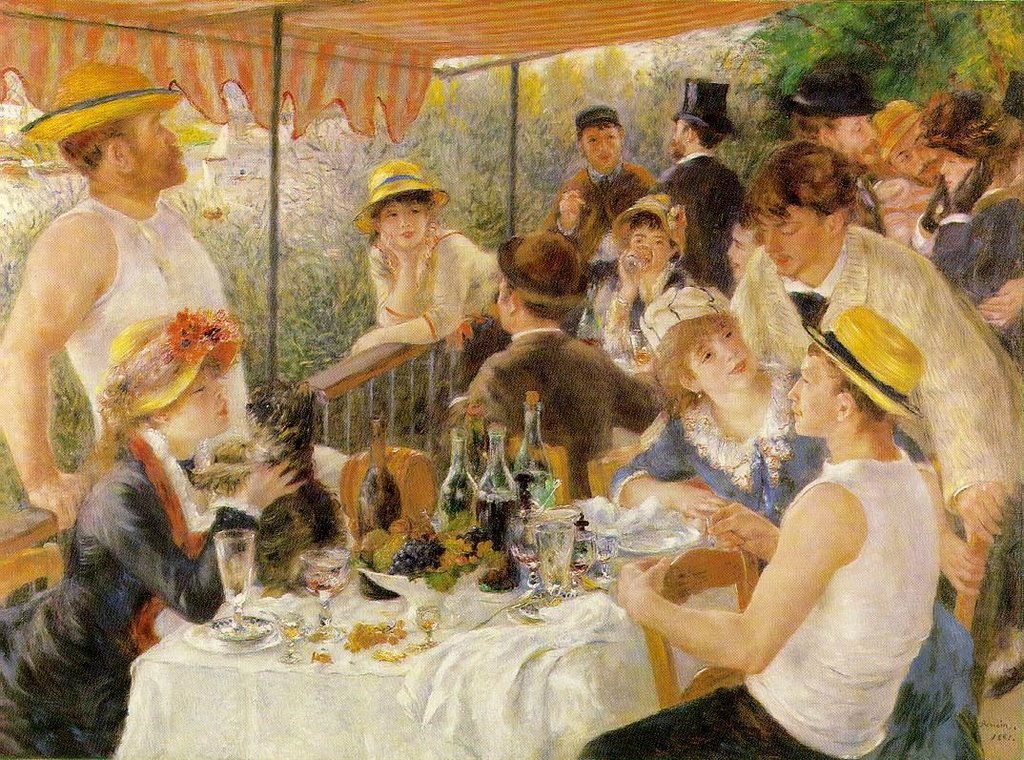
Pierre-Auguste Renoir, Luncheon of the Boating Party

(October 26) I really liked Three Men in a Boat – it’s the buddy movie of its day – the Seinfeld or Mary Tyler Moore Show of the 1880s. It’s very funny. The story is nominally about one trip up the Thames in a rowboat undertaken by three young urban professionals, but this particular trip is really just the backdrop for a series of comic monologues about other boat trips and adventures and about life in general, à la George Carlin or Dave Barry. As the friends get ready for the excursion, for example, J., the narrator, pauses to lampoon weather forecasting and barometers:

Then there are those new style of barometers, the long straight ones. I never can make head or tail of those. There is one side for 10 a.m. yesterday, and one side for 10 a.m. to-day; but you can't always get there as early as ten, you know. It rises or falls for rain and fine, with much or less wind, and one end is "Nly" and the other "Ely" (what's Ely got to do with it?), and if you tap it, it doesn't tell you anything. And you've got to correct it to sea-level, and reduce it to Fahrenheit, and even then I don't know the answer.

The book is fun also because of the sensation of travelling back in time 120 years – paid work is done by children, people move their bathtubs around, a complete supper can be bacon and a jam tart, young men share single beds matter-of-factly. Spookily at one point, J. reverses the time-travel effect by making fun of the fashion of collecting antique china:

Will the prized treasures of to-day always be the cheap trifles of the day before? Will rows of our willow-pattern dinner-plates be ranged above the chimneypieces of the great in the years 2000 and odd?

Well, yes, they will!

It was surprising that interspersed among the funny anecdotes and clever observations are serious little flights of poetic fancy that occasionally verge on the mawkish. I was struck by this one, though:


And yet it seems so full of comfort and of strength, the night. In its great presence, our small sorrows creep away, ashamed. The day has been so full of fret and care, and our hearts have been so full of evil and of bitter thoughts, and the world has seemed so hard and wrong to us. Then Night, like some great loving mother, gently lays her hand upon our fevered head, and turns our little tear-stained faces up to hers, and smiles; and, though she does not speak, we know what she would say, and lay our hot flushed cheek against her bosom, and the pain is gone.

I can’t ever remember encountering a metaphor for Night that presents it as a maternal experience.

Three Men in a Boat and Jerome K. Jerome were unknown to me till I read Robert McCrum of The Observer’s list of the 100 greatest novels of all time a couple of years ago. He put it at No. 33 and called it “one of the funniest English books ever written.” I can easily think of 20 or 30 books that are far funnier, but it’s pretty funny.


Tuesday, October 03, 2006

Empire Falls, Richard Russo

(September 28) Liked it. I picked this up because a booKCEL member recommended Russo to Irving lovers.

I can see why Irving and Russo would be compared -- their novels have many broad characteristics in common (bearing in mind that I'm basing my knowledge of Russo entirely on Empire Falls): there's a motley crew of likable characters, modern New Englanders, who are trying to carry out plain-vanilla lives as best they can while something evil and frightening looms in the background. Despite the dark clouds on the horizon, there's a charming and humorous passage on every page.

But I would say Irving and Russo are fundamentally very different. Or, perhaps, what I think of as "Irving" is a very specific quirkiness in the point of view and in the mapping out of the tale that Russo just doesn't have. Irving is a step away from his characters -- you can hear him lovingly puppet-mastering above the fray. Russo (like many writers) is much closer to his characters, more invisible as a narrator. Irving is also eccentric in the way he tells his characters' stories, often taking up and developing topics and side-stories that never get returned to in the course of the über-story -- which is a way of disarming professional readers, who are used to taking note of seemingly random details, confident they'll later on be woven neatly into the climax of the book.

In some ways, Irving is an "unprofessional" novelist.

Russo is professional -- in both the good and bad senses. Empire Falls is very neatly plotted: all the disparate issues affecting individual characters are brought to bear on the novel's climax, which is a series of surprising, and in some cases shocking, revelations about individual characters' secret intentions. The climax of Empire Falls is quite dramatic, in fact -- way more than any Irving novel ever is.

But Empire Falls is also a bit conventional. You kind of know right off the bat how the chips should fall, and they do fall that way. It's a TV-generation quality. Irving definitely doesn't have that quality.

The best thing about Russo is the witty little turns of phrase he often uses to capture a detail in a scene or the mood of a character. He's in the Dave Barry or Bill Bryson schools of humour, only subtler.

Overarching observation: with The Cider House Rules and Empire Falls, I have spent the month of September in Maine.


Edward Hopper, Nighthawks